
Help, I'm Making Myself Write a Plot. And Sometimes I Enjoy It.
I’m convinced that the general principles of plot preparation don’t depend on the system. Of course, systems tailored to a particular style of play need more thorough preparation in those specific areas: combat, intrigue, exploring the unknown, and whatever else is unique to the chosen system. I’ll mark examples that rely on specific mechanics.
To some extent, preparation is like writing a short story: the beginning is clearly defined, and with every next paragraph, that certainty disappears like tears in rain.
A Sign to Start Writing the Plot
Figure out the plot’s length, subject matter, and tone.
Gather references and sources of inspiration, if you need them.
Focus on what’s important and discard what’s less significant.

A common problem is just getting started. The fear of the blank page came to plot writing from literature, but the way to overcome it is still the same: start writing without thinking about quality or meaning; write any nonsense that comes to mind. Let the first sentence of a story about colonies on the outer frontier be, “One fine morning in the month of May an elegant young horsewoman might have been seen riding a handsome sorrel mare along the the flowery avenues of the Bois de Boulogne” We’ll figure out where she’s going and why later, and it won’t matter if the horsewoman becomes a space pirate aboard a battle dreadnought in the final version. The important thing is to begin.
Later, some elements of the plot will inevitably need to be replaced with better, more thoughtful ones, or simply ones that fit the setting or the group better. So don’t spend time and inspiration trying to make the first draft perfect.
Once the fear of the first page has passed, it’s worth figuring out what we’re writing in the first place. Usually, a basic understanding is enough, and I like to frame it as a set of questions. For example:
| What? | A one-shot, 4–8 hours |
| Where? | Deep space, the near future |
| Genre? | Lovecraftian horror, isolation |
| System? | Call of Cthulhu, 7th edition |
| Tone? | Moderate horror, think Alien |
It doesn’t have to be written out in detail; even this is a start. This is also a good time to jot down sources of inspiration, or at least imagine what the final result might look like.
- A Robin Hood-style band, but hiding in a forest of corporate skyscrapers?
- Caravaners' adventures in the scorching wasteland of a post-apocalyptic future, like Fallout?
- A supernatural murder mystery aboard a storm-bound train, like Murder on the Orient Express?
Some people think borrowing elements from existing works is poor sportsmanship. Others think being a game master is to plagiarize every work of art humanity has ever created. So the real question is whether you believe that all stories have already been told and there is nothing new under the sun.
Last but not least, when writing a plot, it’s important to understand what’s central and what’s secondary. For example, imagine an action-adventure game where the party is driving a bus that will explode if it goes slower than 50 miles per hour. In this case, it would be much more useful and interesting for the players to know how the bus works than to know the shopkeeper’s family tree in the village they will race through in six seconds of in-game time. Conversely, when the group is attending a reception at the king of Breland’s palace, someone will inevitably ask how that suspicious count at the far end of the hall is related to the king, rather than asking for a complete list of gluten-containing appetizers.
Act accordingly: the key aspects of the plot deserve more time and detail, while everything else can be captured in a few bullet points.
Experience shows, however, that some groups will look for gluten in the bus’s fuel. That’s okay.
Advice and Techniques That Work (For Me)
A comprehensive description of the setting and characters with well-developed motivations, placed on a reasonable timeline, is half the battle.
The other half is presenting it coherently and being ready for everything to inevitably go wrong.

My favorite approach to plotting is probably to describe the setting where the events take place, add some interested characters, and then let the players loose in it. This might sound like a sandbox, but there are a few nuances.
The Setting as the Plot’s Driving Force
In heroic fantasy, like classic D&D, the plot often revolves around the heroes. That’s to be expected, since the fantasy is heroic. A sandbox is more about interacting with the world, while in a setting-driven plot, the players are like a bard following the party and writing an epic ballad. Instead of “The party interacts with the world,” we take “The world reacts to the party’s actions.” It sounds similar, but shifting the heroes from a reactive to a proactive role can work wonders for how the game feels.
If, on the other hand, the setting is one where the characters are no more than dust on the tentacles of cosmic horror, as in Call of Cthulhu, then the plot is what happens while the investigators are doing nothing. The sandbox is still about interacting with the world, but while the group is buying new iPhones, the ancient evil is carrying out its plan. A well-designed setting accounts for this. Took the subway? You missed the library’s opening hours. Decided to sleep? The cultists work at night.
This may sound like punishing the players for refusing to follow the plot rails, but that’s not quite right. The key is intent: if everyone knows at the start of the game that it’s noon on Monday, then choosing to sit in a café for six hours means the group will inevitably miss the places that close at 6 p.m.
And in the meantime, the antagonists are leveling up.
Characters Instead of Archetypes
Sometimes it’s enough to say that the antagonist is evil just because they’re evil. That works great for a classic dungeon crawl, a short combat-heavy adventure, a road movie - and that’s just a few examples. In that case, we have a villain archetype who does what they need to do to keep the plot moving. In other words, they’re a plot device, a generalized character type. Seen one, seen them all.
This isn’t limited to antagonists. Friendly NPCs who hang around in limbo between interactions with the group, with nothing happening to them. Party companions whose names are forgotten five minutes later and who are seen as just another token on the board. And many other archetypes who feel like plot devices or functions.
These characters have their place, but only in a format like, “You go to the smithy, and the blacksmith repairs your weapon.” The encounter begins and ends in one sentence. The blacksmith was there, the blacksmith repaired the weapon, and essentially they’re nothing more than a game function.
Actual characters, on the other hand, have an intention, a goal, a plan, skills, and usually some characterization. Most importantly, they act even when no one is watching.
Which means the clocks are ticking.
A Timeline That Starts a Little Earlier
The ritual to summon Hastur begins long before the stars are right.
A heist plan is made before the opportunity presents itself.
Construction of a doomsday machine doesn’t begin on the day it’s switched on.
Rome wasn’t built in a day, either.
That’s why I like to find the point from which the plot develops, extrapolate events, and then decide when the game begins.
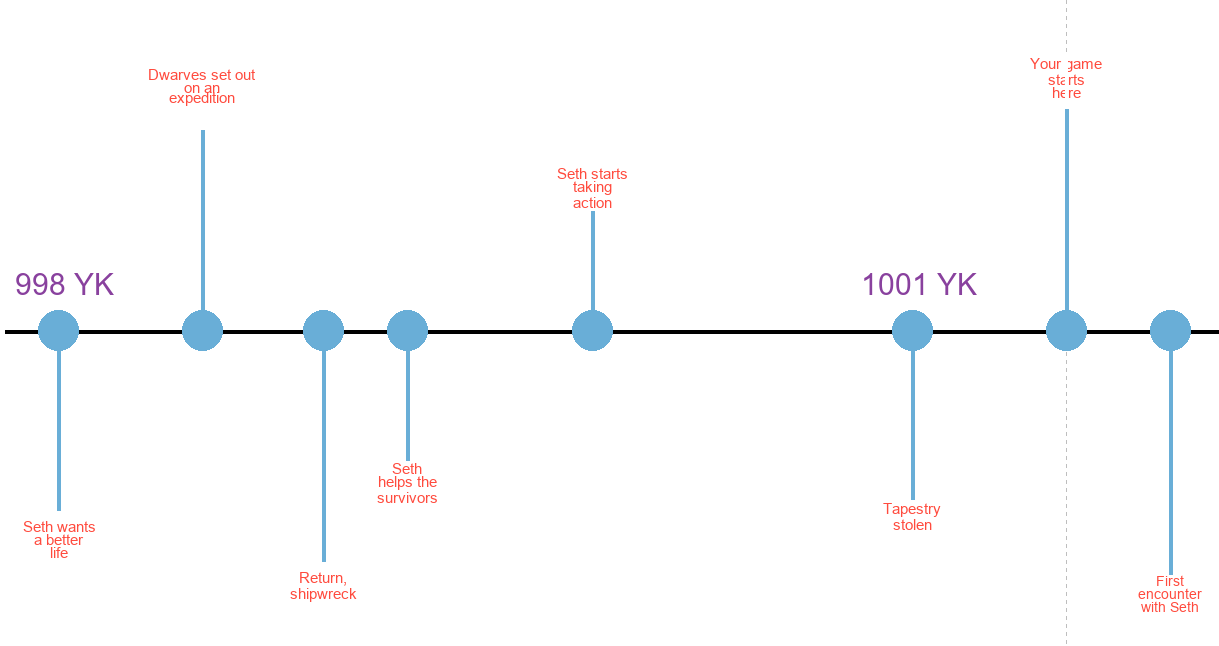
Let’s say there’s an antagonist named Seth. He reached the ancient underground ruins of a long-vanished empire and took possession of an artifact that makes him nearly omnipotent.
Or at least, that’s his plan. Let’s work backward.
- The end of Seth’s story arc: possessing the artifact. There’s more to it, but let’s focus on this.
- In the meantime, Seth searches for the ruins, gathers minions, studies magic, collects components, and does everything needed to make his plan succeed. The ends justify the means, he tells himself.
- Seth begins his search after finding vague testimony from dwarves who survived a shipwreck. Every one of them speaks of lands filled with unimaginable wealth and magic. He believes it must be true.
- But Seth’s real story begins when, after graduating from a magical university, he gets stuck in a small town as its local wizard. He lights bonfires (cheaply!) for harvest festivals, puts magical tracking marks (won’t wash off!) on mining carts, removes wart curses (guaranteed!) and realizes that at thirty, he wants more from life - and can get it.
What Does This Tell Us?
Seth has an intention, a goal, a plan, skills, and a little characterization. And all that in four simple steps. Somewhere around step two, he becomes the antagonist. And around step two, the group of heroes enters the picture: they’ve been hired to find a tapestry that disappeared from a museum. I don’t yet know why Seth wants the tapestry; this section is about the timeline.
Now let’s open some online timeline-making tool or Canva, and make something like this:
How Much Detail Should I Write?
Enough to make the world feel alive and make it easy for the game master to improvise based on the information at hand. That’s enough; add more if you like.
I’ve seen game masters turn a single sentence in their notes into an entire scene. So it really is a personal thing.
The harder part is presenting it coherently and logically, so the group understands it fully.
Show, Don’t Tell
Of course, it’s quick and easy to tell the players about the dangers lurking in a cursed forest.
But describing the skeleton of a giant lying with its feet pointed toward the trees at the forest’s exit creates more atmosphere while conveying the same message. It was running away, but didn’t make it. What’s more, if the group starts examining the skeleton, you can hint at the danger through its wounds and other clues.
Whatever the location, danger, or setting, gradually raising the stakes and revealing plot-critical events in measured doses creates the impression of a deep, carefully crafted story - even when it isn’t.
And It Might Not Happen
Cursed with foreknowledge, full of an understanding of how things were supposed to go, and poisoned by dreams of what will never happen, game masters have to react in real time when the plot falls apart. This is one reason I mentioned improvisation earlier: with so many unknowns, and no way to know what the players will do, a meticulously written plot is simply extra prep work. So another important part of preparation is learning to “let go” of your creation.
A lovingly written antagonist?
A location that reveals an ally’s tragic backstory?
Because, however you look at it, the plot is made up,
while the players and the memories you make together are real.
Now We Have to Figure Out How to Finish This
A game plot isn’t a book; it gets written as you play.
The endings you planned may never happen, and that’s okay. Writing them out in great detail may be unnecessary.
Endings aren’t easy. With countless events yet to happen, there can be as many endings as you like. But that’s the charm: every decision matters, even though you never know just how much the one you’re making here and now matters.
And let’s be honest: if the goal were to have a completely controlled plot in a sterile environment, my best advice would be to write a book. Tabletop roleplaying games have the undeniable advantage of unpredictability and chaos. That chaos is somewhat controlled, but still untamed.
Usually, there is more than one player at the table, and everyone brings something of their own. That’s what creates the unique experience of a shared story.
So no planned ending is set in stone. Still, you can sketch out some possible endings:
- The heroes succeed.
- The antagonist succeeds.
- The heroes stop the antagonist but sacrifice themselves in the process.
- The heroes join the antagonist.
- Something completely unexpected.
And It Might Not Happen
I once ran a wonderful Murder on the Eberron Express.
My mistake?
I made it part of a campaign. So the characters had various magical items, and after the opening, when the party finds itself on the train, one player asked to make a secret move.
We stepped aside to discuss it. His character had everything needed:
- A narrative reason to do it
- The necessary items and skills
- Enough intelligence to reproduce the player's calculations
- The personality traits needed for the idea
- A lawful evil alignment
So the character put an Immovable Rod into the coupling connecting two train cars.
The plot went off the rails, both literally and figuratively.
Sure, I could have said, “No, that’s not how it works.” I could have described the process breaking the item or the character’s hands. But it was fun, unusual, and the players loved it. Would it have been better if it hadn’t happened? We’ll never know, and that’s the best part about unplanned endings.
To sum up, this all works for me when I prepare a plot. But the most important thing is:
Plot preparation is a very personal process. If someone tells you there’s only one right way, they simply don’t like you.